Networking and Referrals, The Real Impact of Getting a Job Through Connections
Picture two software engineers. Both are senior backend developers, both work with the same tech stack, and even their GitHub profiles look similar. The first one toggled the "Open to Work" badge on LinkedIn, applied to 80 listings over three months, made it to 11 phone screens, 2 finals, and got stuck on 1 offer. The second one sent a message to a former teammate: "Any openings on your side?" Within three weeks, she signed at the new company, and because she came through the referral channel, the hiring manager met her on day one.
The difference is not talent. It's the channel. In the Türkiye software market, the referral channel has quietly become a filter that corporate HR officially accepts but rarely talks about. A meaningful portion of the energy you spend polishing your CV can be replaced by sending a two-paragraph message to the right person.
In this post, we'll talk about why the referral channel is so effective, how to build one, and what concrete difference it makes at the application, interview, and salary stages.
The Invisible Edge of a Referral
You have to look at it from HR's side. When a senior backend role opens, an average of 200-400 applications come in. Each CV gets 6-8 seconds of attention. The ATS (applicant tracking system) matches keywords, 15-20 candidates make it to a phone screen, and 5-7 reach the technical interview.
The referred candidate skips that funnel. They land directly in the hiring manager's inbox. Often the ATS score isn't even checked, because someone inside has said, "I trust this person." That signal is valuable to HR because it lowers the risk of the hire.
Three reasons why the referral channel moves fast:
- Filter bypass: CV scans, automated screening, and the initial HR call are largely skipped.
- Trust transfer: If the referrer is trusted internally, part of that trust transfers to you.
- Information asymmetry: You walk into the room already knowing the team culture, the tech debt, the manager's style - things that aren't in the job description.
There's an economic angle too. Many companies pay a referral bonus of 10,000-25,000 TL for an employee referral. So the referrer also benefits, which keeps the channel alive.
Share of the Referral Channel in the Türkiye Market
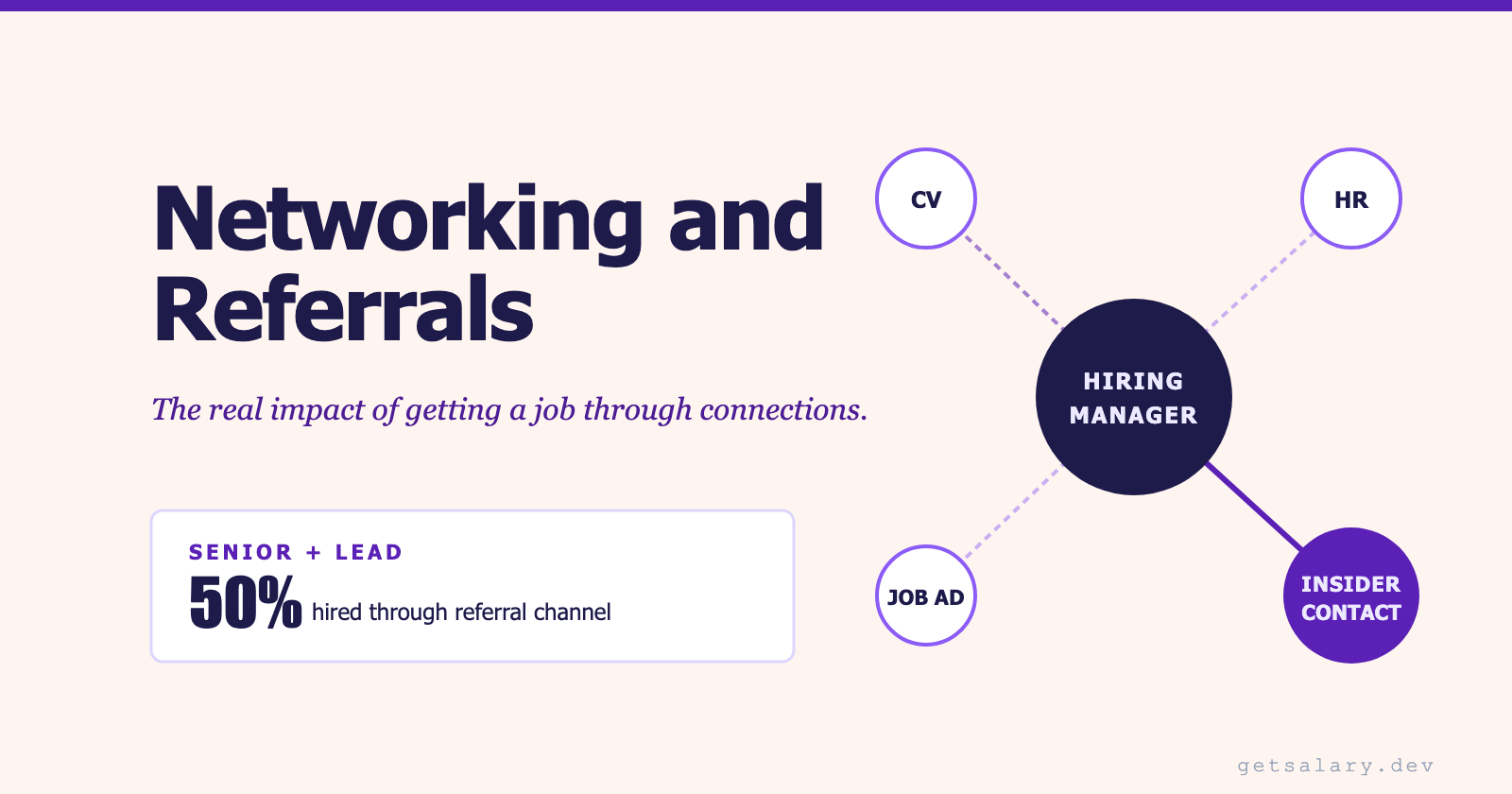
In the getSalary 2026 data, roughly one in three software engineers said they got their current job "through a connection." At senior and above, the share rises sharply; at Lead and Principal, it crosses 50%. At Junior and Mid, it stays in the 20-25% band.
The pattern makes sense. Companies don't want to take risks on senior hires. The wrong Lead means six months of lost output and a year of damaged team morale. That's why senior roles are usually circulated through the network first and often closed before they ever hit a job board.
The numbers say:
| Level | Referral Share | Average Interview Cycle |
|---|---|---|
| Junior | 18-22% | 3-5 weeks |
| Mid | 25-30% | 3-4 weeks |
| Senior | 35-40% | 2-3 weeks |
| Lead | 50-55% | 1-2 weeks |
| Principal | 55-65% | 1-2 weeks |
Interview cycles are noticeably shorter through referrals. The practical meaning: if you're job hunting during your notice period, the referral channel saves you from running out the clock.
Strong Ties vs. Weak Ties
There's a classic finding in sociology: when it comes to finding a job, your closest friends help less than your "weak ties." That is, people you don't see often, the ones you message once a month, your former colleagues. The reason is simple. Your inner circle generally knows about the same opportunities you do; your outer circle knows the ones you don't.
In practical terms, there are three types of ties:
- Strong ties: Your current teammates, your 2-3 closest friends. Few in number, limited in impact, because they see the same world you see.
- Weak ties: Former coworkers, meetup acquaintances, open-source contributors you've crossed paths with, old internship friends. Many in number, high in opportunity diversity.
- Bridge ties: People outside your sector who have access to a different network. External recruiters, CTOs you met at a conference, founders in adjacent industries.
The classic mistake is to think "let me network" and immediately message your strong ties. In reality, most doors open through weak and bridge ties.
How to Build a Referral Channel
Most people start networking the moment they start job hunting. The right timing is the opposite. You build the network while you have a job; you use it when you need it.
For a sustainable referral network, these practices work:
Don't lose touch with former colleagues.
Sending a goodbye email when you leave a company is a cliche, but it matters. A short message three months later - "How are things on your side?" - can turn into an offer two years down the line. Don't be transactional here; be genuine.
Show up at community events, but don't be the salesperson.
Devnot, Kommunity, sector meetups, JS Türkiye, and similar communities are ideal for producing weak ties. But don't be the person trying to hand out a CV at every conversation. Listen, ask questions, then connect on LinkedIn afterwards. The real return shows up six months later.
Contribute to open source and produce technical content.
Pushing patches on GitHub, writing on Medium or your personal blog, or sharing a useful prompt set during this AI moment - all of these create passive network. People know you before they meet you.
Use LinkedIn as a content channel.
Don't only post when you start a new job. Occasionally share what you learned, a problem you solved with your team, the book you're reading. The algorithm rewards it, your former coworkers see it, and they remember. For visibility on your CV and LinkedIn profile, you can take a look at our CV and LinkedIn guide for developers.
Leave your last manager on good terms.
How you behave during your notice period directly determines the quality of your next two references. The seriousness you show during handover is what earns you the sentence "I know this person, I'd vouch for them" five years later.
The Right Way to Ask for a Referral
When you ask for a referral, you have to avoid two extremes - both exploiting goodwill and being too hesitant. The right tone sounds like: "I'm asking, but only if it's not a burden."
A good referral ask has this shape:
- Context: Bring back the old connection, say what you're looking for.
- Specific request: Instead of "refer me," ask "could you put in a sentence for this role?" - something concrete.
- Exit door: Leave room for the other person to say no.
- Your share of the work: Send the CV link ready, save them time.
Sample message:
Hey Burak, how's it going? I still remember that final demo at the company, those were good days. I saw a Senior backend opening on your side (Acme Software) and I think I'd be a fit. If you're comfortable, would you be willing to put in a short referral? If not, totally fine - I'll go through another channel. Leaving the CV here: link.
The message does several things at once. It opens with a personal memory, it states the ask clearly, it keeps the no-door open, and it doesn't dump work on the other person.
What not to do:
- Don't blast the same message to 50 people in one day.
- Don't follow up repeatedly when you don't get a reply.
- Don't try to claim credit for the referrer's work. If you get the interview, report back, thank them.
Cold Networking: Asking a Stranger for a Referral
Sometimes you don't know anyone at the company you're targeting. That's where cold networking comes in - reaching out to a stranger on LinkedIn who works there.
Success rates here are low but not zero. Things that lift the response rate:
- Targeted profile: Aim for someone at your level, not the hiring manager or team lead. For them, an acquaintance that ends in a referral bonus is more attractive.
- Specific reference point: Instead of "I'd like to apply to your company," try "I read your blog post and I'm curious about the monorepo migration on your team."
- A 15-minute coffee ask: Framing it as "I'd like to learn from your experience" instead of "I want a job" triples the response rate.
- If no reply, one reminder after a week, then back off.
Getting into the referral channel through cold networking often produces faster results than applying and disappearing into an ATS.
How the Interview Flow Changes With a Referral
When you come through the referral channel, the interview process diverges from the classic flow at three points:
1. The HR phone screen can be skipped.
If there's a known person inside, HR often goes straight to the technical stage. That saves time and spares you from the tiring "why are you switching companies?" loop.
2. The first technical conversation feels less guarded.
The hiring manager has heard something about you from the referrer. That softens the first ten minutes considerably. The depth of questions also tends to rise, because basic skill verification is assumed to have happened through the social channel.
3. Reference checks work for you, not against you.
In the classic flow, reference checks happen before the offer and act like a risk gate. In the referral channel, they become the evidence that triggers the offer. The answer to "what do you think of this person?" can directly land in the salary part of the offer.
For interview-stage details, take a look at our interview prep guide for software engineers in Türkiye.
The Referral Effect on Salary Negotiation
The referral channel cuts both ways at the negotiation table.
The upside: the company already trusts you, sees lower risk, and skips extra costs (recruiter commissions, ATS license overhead). That can translate into more flexibility on their side at the table.
The downside: the air of "we created this role for you, do us a favor in return" can creep in. Some hiring managers will try to dress up the referral advantage as a "discount." A typical line is "you're already Burak's friend, our maximum budget at this level is X."
To protect yourself from this trap:
- Even if you came through the referral channel, refuse to bring the referral into the negotiation. "My relationship with Burak is one thing, contract terms are another."
- Set your range expectation in advance. To know the market data, our getSalary 2026 software salary guide helps here.
- Don't use the referrer as leverage in the negotiation. Their gain materializes when you start; don't push it past that.
The negotiation room is somewhat narrower in the referral channel because the process is short and both sides feel familiar. But that doesn't mean you should sign below market. Total compensation, flexible benefits, and the annual raise mechanism are all open ground for conversation.
What to Do When You Don't Have a Referral
Seeing the power of networking can sometimes flip into demotivation: "I don't have one, so I don't have a chance." That's not true. If you don't have a referral, your strategy changes:
- Produce passive network. GitHub, blog posts, LinkedIn content - all of these separate you from the average applicant. Even on a cold application, the HR person who picks up your file may already remember your name.
- Start building the network early. The person you meet two years before job hunting becomes your referrer two years later. Even if you're searching now, start investing in the network today for the next round.
- Build a good relationship with recruiters. Recruiters work like an organized referral channel. Once you're inside their list, sending your CV to the next role takes minutes.
- Contribute to the community. Open-source PRs, meetup talks, blog posts - all generate passive references. "This person made strong contributions on that project" is effectively a concrete reference.
Even at Junior level, when the referral channel is weaker, the classic application path still works for entry-level roles. Our how to start a software career guide goes into detail on this process.
The Dark Side of the Referral Channel
Like every powerful channel, the referral channel comes with habits worth avoiding.
People hired via referral are seen as "loyal" but often disappear through the same channel on the way out.
When a former teammate brings you in and you decide to leave that company, you feel responsible to both yourself and them. That psychological tie sometimes keeps you longer than you should stay. If you receive a counter-offer, our counter-offer decision guide is worth a read in this exact situation.
Without diversity in your network, you fall into an echo chamber.
If you only network with people from your previous company, they'll keep recommending the same kind of company. Maintaining variety across company types and cities helps you avoid this.
Every referrer turns into a question mark when you leave too.
If you leave on bad terms, five years later "Burak, I'm resigning" won't be enough; the silent question becomes "How long did you stay at the job Burak got you?" That's why the referral channel multiplies the value of professional behavior.
Plenty of people refer you while quietly planning their own exit.
You might start a job not knowing that the person who referred you will move to another company in six months. Then you find yourself alone on the team you joined to work with them. Before signing, a polite "How long have you been there, what are your plans?" is fair.
Practical Takeaway
The referral channel is an advantage that comes before polishing your profile. That doesn't mean your CV and technical skills don't matter; it means the order changes. When you find the right contact, the door opens in 30 seconds. After that, you carry your own weight with your profile, your interview, and where you stand at the salary table.
Ask yourself these three questions this week:
- Across my last three jobs, with how many people have I kept in contact?
- Could I name 5 companies where my former colleagues currently work?
- Have I written down the first 10 people I could ask for a referral?
The weaker the answers, the more urgent it is to start investing in your network today. Not when you're job hunting - while you still have a job. So when you need the channel tomorrow, it's already there.
To see where your salary stands in the market and to base career decisions on data, the getSalary Dashboard is waiting.